
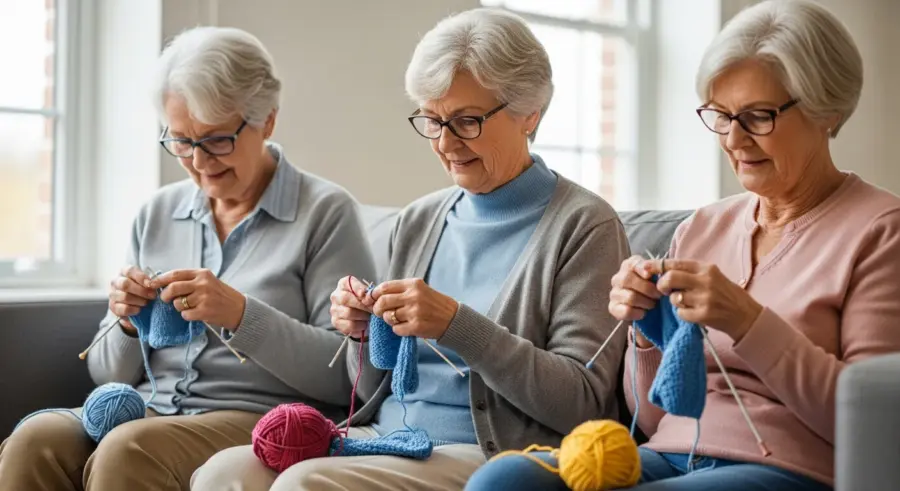
Knitting is more than just a hobby; it’s a way to connect, create, and care for your well-being. For seniors, the rhythmic motion of the needles can be particularly soothing, offering a chance to relax and engage in a fulfilling activity.
If you’re looking to pick up a new skill or rekindle an old passion, joining senior knitting groups can offer a supportive and social environment. Learning together can be a rewarding experience, opening doors to new friendships and shared interests.
This article will guide you through the numerous benefits of knitting, essential supplies for beginners, basic techniques, and how to find local and online knitting communities. We’ll also explore simple knitting projects perfect for seniors just starting out.
Benefits of Knitting for Seniors
Knitting offers many advantages for seniors, impacting both physical and mental health. The repetitive motion of knitting can improve dexterity and reduce symptoms of arthritis.
It’s a gentle exercise that keeps hands and fingers nimble, which can be especially beneficial for those experiencing stiffness or discomfort. Knitting can also help maintain fine motor skills, crucial for everyday tasks like writing and buttoning clothes.
Beyond the physical benefits, knitting is a fantastic mental workout. It requires focus and concentration, helping to keep the mind sharp and engaged.
The act of following knitting patterns seniors can also improve cognitive function, enhancing memory and problem-solving skills. The rhythmic, repetitive nature of knitting has a calming effect, reducing stress and anxiety.
It’s a meditative activity that allows seniors to unwind and find a sense of peace, similar to yoga or tai chi. Knitting provides a sense of accomplishment and purpose, especially when creating something tangible like a scarf or blanket.
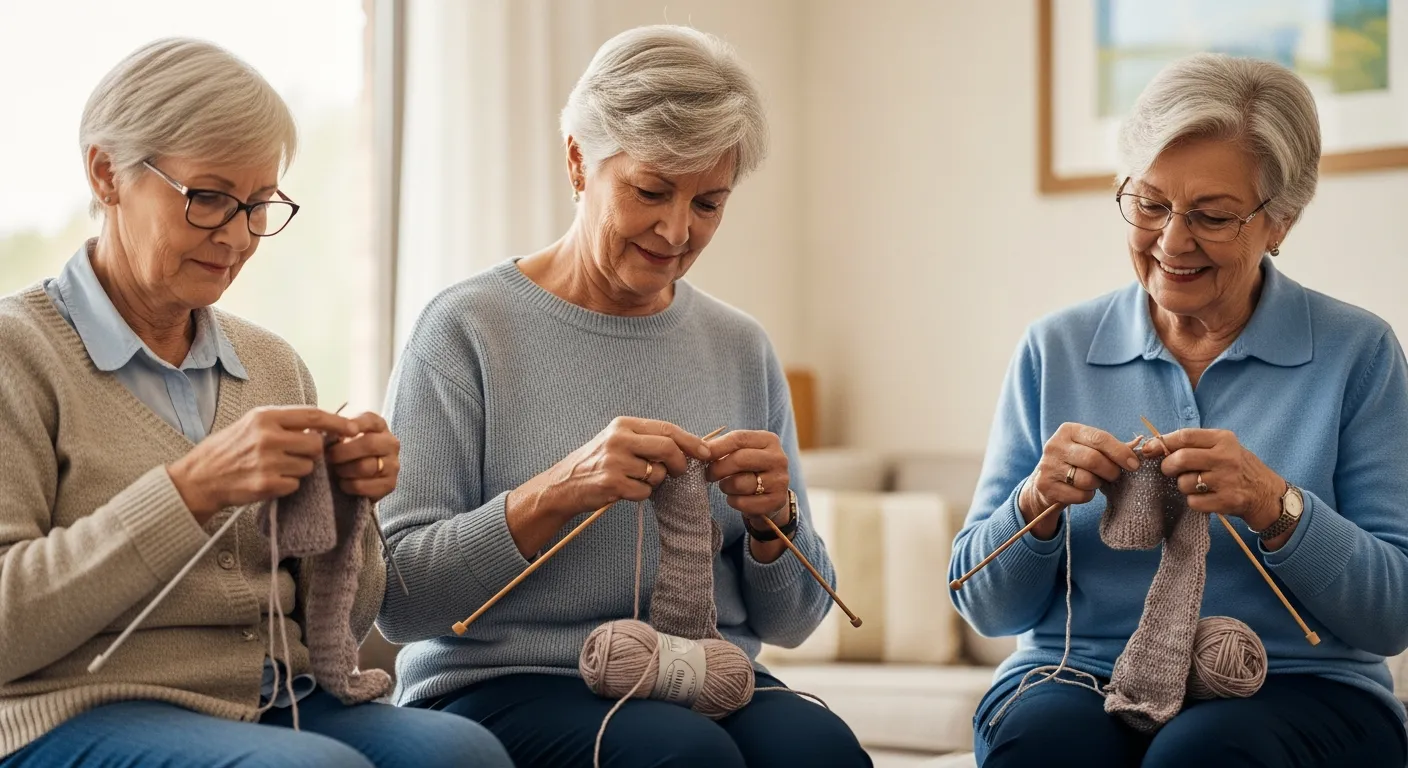
This can boost self-esteem and combat feelings of loneliness or isolation. The social aspect of knitting is another significant benefit, as senior knitting groups offer opportunities for connection and friendship.
Sharing a common interest can lead to meaningful relationships and a sense of belonging. Many groups also participate in charitable knitting projects, providing a way to give back to the community and make a difference in others’ lives.
Furthermore, knitting can be a wonderful way to stay active and engaged during retirement. It provides a structured activity that can fill the time and give a sense of routine.
The act of creating something beautiful and useful can be incredibly satisfying. This sense of achievement can contribute to an overall feeling of well-being and happiness.
Knitting can also serve as a form of self-expression. Seniors can choose colors, patterns, and designs that reflect their personal style and creativity.
The possibilities are endless, from creating personalized gifts for loved ones to crafting unique items for themselves. It’s a hobby that can be adapted to suit individual preferences and abilities.
The concentration required for knitting can also help to improve focus and attention span. This can be particularly beneficial for seniors who may be experiencing age-related cognitive decline.
Knitting can also be a great way to pass down traditions and skills to younger generations. Grandparents can teach their grandchildren how to knit, creating a special bond and preserving a valuable craft.
This intergenerational connection can be incredibly enriching for both seniors and their families. It fosters a sense of continuity and shared history.
Finally, knitting is a relatively low-impact activity that can be enjoyed by people of all ages and abilities. It’s a gentle way to stay active and engaged, without putting excessive strain on the body.
This makes it an ideal hobby for seniors who are looking for a relaxing and fulfilling way to spend their time.
Essential Knitting Supplies for Beginners
Starting to knit doesn’t require a huge investment or a lot of fancy equipment. The basic knitting supplies beginners need are relatively inexpensive and easy to find.
First, you’ll need a pair of knitting needles, and size 8 (5mm) is a good starting point for beginners. These needles are versatile and work well with a variety of yarn types.
Next, you’ll need yarn, and a smooth, light-colored worsted weight yarn is ideal. Light colors make it easier to see your stitches, and worsted weight is a good thickness to learn with.
Acrylic or wool yarns are both good choices for beginners, as they are durable and easy to work with. Avoid fuzzy or novelty yarns at first, as they can be more difficult to manage when learning.
A yarn needle, also known as a tapestry needle, is essential for weaving in the ends of your yarn after you finish knitting. These needles have a large eye that makes it easy to thread the yarn.
Scissors are also necessary for cutting the yarn. A small pair of sharp scissors will do the trick.
Finally, stitch markers can be helpful for keeping track of your place in a pattern. These small rings or clips can be placed on your needle to mark the beginning or end of a row or to indicate a specific point in your knitting.
Beyond the basics, consider a few optional but helpful items. A row counter can be useful for keeping track of your progress, especially on projects with repeating patterns.
A needle gauge is a handy tool for determining the size of your knitting needles, which can be helpful if you’re using needles that aren’t clearly labeled. A small bag or container to store your supplies can also be useful for keeping everything organized.
When choosing knitting needles, consider the material. Needles come in a variety of materials, including wood, metal, and plastic.
Wood needles are warm and comfortable to hold, while metal needles are smooth and allow the yarn to slide easily. Plastic needles are lightweight and inexpensive.
For yarn, pay attention to the care instructions. Some yarns are machine washable, while others require hand washing.
Choose a yarn that is appropriate for the project you’re planning to make and that fits your lifestyle. Consider the weight of the yarn as well.
Yarn weight refers to the thickness of the yarn, and it’s important to choose a weight that is appropriate for your project and your needles. Worsted weight yarn is a good all-around choice for beginners.
Don’t be afraid to experiment with different types of yarn and needles to find what works best for you. Knitting is a personal journey, and there’s no one right way to do things.
The most important thing is to have fun and enjoy the process of creating something beautiful with your own two hands.
Basic Knitting Stitches and Techniques
Learning to knit involves mastering a few basic stitches and techniques. These techniques form the foundation for more complex patterns.
The knit stitch and the purl stitch are the two most fundamental stitches in knitting. The knit stitch creates a “V” shape on the front of your work, while the purl stitch creates a horizontal ridge.
| Stitch/Technique | Description | Use |
|---|---|---|
| Knit Stitch | Creates a “V” shape | Basic fabric |
| Purl Stitch | Creates a horizontal ridge | Ribbing, texture |
| Casting On | Creating initial stitches on needle | Starting a project |
| Binding Off | Securing the stitches | Finishing a project |
Casting on is the method of creating the initial stitches on your needle to begin a project. There are several different cast-on methods, but the long-tail cast-on is a popular choice for beginners because it’s easy to learn and creates a neat edge.
Binding off is the technique used to secure the stitches at the end of your project, preventing them from unraveling. This creates a finished edge.
Once you’ve mastered the knit and purl stitches, you can start to explore more advanced techniques. Ribbing is a common technique that involves alternating knit and purl stitches to create a stretchy, textured fabric.
Increasing and decreasing stitches are used to shape your knitting. Increasing adds stitches to your work, while decreasing removes stitches.
These techniques are essential for creating items like hats, sweaters, and socks. Reading knitting patterns is a crucial skill for any knitter.
Patterns typically use abbreviations and symbols to represent different stitches and techniques. Learning to decipher these patterns will open up a world of knitting possibilities.
Pay close attention to the gauge specified in the pattern. Gauge refers to the number of stitches and rows per inch, and it’s important to match the gauge in the pattern to ensure that your finished project will be the correct size.
Practice makes perfect when it comes to knitting. Don’t be discouraged if your first few projects aren’t perfect.
The more you knit, the more comfortable you’ll become with the stitches and techniques. There are many resources available to help you learn, including books, websites, and videos.
Take advantage of these resources and don’t be afraid to ask for help when you need it.
Finding Local Knitting Groups and Clubs
One of the best ways to enhance your knitting experience is by joining a local knitting group or club. These groups offer a supportive environment where you can learn from others, share your projects, and make new friends.
A great place to start your search is at your local yarn store. Many yarn stores host knitting groups or classes, providing a convenient way to connect with other knitters in your area.
These stores often have bulletin boards or websites where they advertise upcoming events and group meetings. Community centers and senior centers are another excellent resource for finding local knitting groups.
These centers often offer a variety of activities and programs for seniors, including knitting and other crafting groups. Check your local library for knitting groups or workshops.
Libraries sometimes host crafting events as part of their programming, providing a free and accessible way to get involved. Online directories and social media platforms can also help you find knitting groups in your area.
Websites like Ravelry have forums where you can search for local groups or connect with other knitters nearby. Social media platforms like Facebook and Meetup are also great places to find knitting groups, where you can search for groups in your area or create your own.
When searching for a knitting group, consider the size and focus of the group. Some groups are small and intimate, while others are larger and more social.
Some groups focus on specific types of knitting, such as lace knitting or sock knitting, while others are more general. Visit a few different groups to find one that is a good fit for you.
Don’t be afraid to try out a few different groups before committing to one. Knitting groups can provide a sense of community and belonging.
Sharing your passion for knitting with others can be incredibly rewarding. You can learn new techniques, get inspiration for your projects, and make new friends who share your interests.
Knitting groups can also be a great way to give back to the community. Many groups participate in charitable knitting projects, such as knitting blankets for homeless shelters or hats for cancer patients.
Working together on these projects can be a meaningful way to make a difference in the lives of others. If you can’t find a local knitting group that meets your needs, consider starting your own.
It’s easier than you might think to create a welcoming and supportive knitting community. All you need is a space to meet, a few interested knitters, and a shared love of the craft.
Online Knitting Resources and Communities
If you can’t find a local knitting group or prefer to learn from the comfort of your own home, there are many online resources and communities available. These resources can provide tutorials, patterns, and support.
Ravelry is one of the most popular online knitting communities. It offers a vast database of knitting patterns seniors can browse, forums where you can ask questions and share your projects, and groups where you can connect with other knitters from around the world.
- YouTube channels with knitting tutorials
- Knitting blogs with patterns and tips
- Online knitting courses and workshops
- Social media knitting groups
- Virtual knitting meetups
Knitting blogs are another great resource for finding patterns, tutorials, and tips. Many experienced knitters maintain blogs where they share their knowledge and expertise, offering valuable insights for beginners.
Online knitting courses and workshops can provide structured learning experiences. These courses often cover a range of topics, from basic stitches to more advanced techniques, and can be a great way to improve your skills.
YouTube is a treasure trove of knitting tutorials. You can find videos that demonstrate every stitch and technique imaginable.
Many experienced knitters have their own YouTube channels where they share their knowledge and expertise. Social media platforms like Instagram and Facebook are also great places to find knitting inspiration and connect with other knitters.
You can follow your favorite knitters, share your own projects, and participate in online knitting challenges. Virtual knitting meetups are becoming increasingly popular.
These online gatherings allow you to connect with other knitters in real-time, share your projects, and ask questions. They can be a great way to build community and feel connected, even when you’re knitting alone at home.
When using online resources, be sure to evaluate the credibility of the source. Look for reputable websites, experienced knitters, and clear, concise instructions.
Don’t be afraid to ask questions and seek clarification when needed. The online knitting community is generally very supportive and welcoming to beginners.
Take advantage of the wealth of information and resources available online to enhance your knitting journey.
Simple Knitting Projects for Seniors
Starting with simple knitting projects is a great way for seniors to build confidence and master basic techniques. These projects are typically quick to complete and require minimal skills.
A basic garter stitch scarf is an excellent first project. The garter stitch is simply knitting every row, creating a simple, textured fabric that is perfect for a scarf.
A dishcloth or washcloth is another easy and practical project. These small squares can be knit in garter stitch or stockinette stitch, providing an opportunity to practice both knit and purl stitches.
A simple hat is a slightly more challenging but still manageable project for beginners. Knit in the round on circular needles, a basic hat can be completed in a few hours and provides a sense of accomplishment.
A blanket square is a great way to contribute to a larger project. Many knitting groups create blankets for charity by knitting individual squares and then joining them together.
Knitting a simple cowl or neck warmer is also a good choice for beginners. Cowls are typically knit in the round and require only basic knitting skills.
Consider knitting baby items, such as booties or blankets. These projects are small and quick to knit, making them perfect for beginners.
They also make wonderful gifts for new parents. Mug cozies are another fun and easy project.
These small sleeves slip over your mug to keep your drink warm and protect your hands from the heat. They can be knit in a variety of colors and patterns.
Simple wrist warmers are a great way to keep your hands warm and cozy during the colder months. They can be knit in garter stitch or ribbing and require only a small amount of yarn.
Bookmarks are a quick and easy project that can be personalized with different colors and patterns. They make great gifts for book lovers.
As you gain confidence and skills, you can start to tackle more challenging projects. Don’t be afraid to experiment with different stitches and techniques.
The most important thing is to choose projects that you enjoy and that will keep you motivated. Remember to celebrate your accomplishments along the way.
Each finished project is a testament to your hard work and creativity.
Yarn Types for Knitting
Choosing the right yarn is an important aspect of knitting, affecting the look and feel of your finished project. There are many different types of yarn available, each with its own unique characteristics.
Wool is a popular choice for knitting, known for its warmth, durability, and elasticity. It’s a natural fiber that comes from sheep and is available in various weights and textures.
Acrylic yarn is a synthetic fiber that is inexpensive, easy to care for, and available in a wide range of colors. It’s a good choice for beginners because it’s durable and can withstand repeated washing.
Cotton yarn is a natural fiber that is soft, breathable, and absorbent, making it ideal for warm-weather projects like dishcloths and baby blankets. It doesn’t have much stretch, so it’s best suited for projects that don’t require a lot of elasticity.
Alpaca yarn is a luxurious natural fiber that is incredibly soft and warm. It comes from alpacas and is often blended with other fibers like wool or silk to enhance its properties.
Novelty yarns come in a variety of textures and colors, adding unique visual interest to your projects. However, they can be more difficult to work with, so they’re best left for more experienced knitters.
When choosing yarn, consider the weight of the yarn. Yarn weight refers to the thickness of the yarn, and it’s typically categorized into different weights, such as lace, fingering, sport, DK, worsted, and bulky.
The weight of the yarn will affect the gauge of your knitting and the overall look and feel of your finished project. Pay attention to the care instructions for the yarn.
Some yarns are machine washable and dryable, while others require hand washing and air drying. Choose a yarn that is appropriate for the project you’re planning to make and that fits your lifestyle.
Consider the fiber content of the yarn. Different fibers have different properties, such as warmth, softness, and durability.
Choose a fiber that is appropriate for the project you’re planning to make and that you enjoy working with. Don’t be afraid to experiment with different types of yarn.
Trying out different fibers and weights can help you discover what you like best and what works best for different projects. Visit your local yarn store to see and feel different yarns in person.
This can help you make a more informed decision about which yarn to choose. The staff at your local yarn store can also provide valuable advice and guidance.
Tips for Comfortable Knitting
To ensure a comfortable and enjoyable knitting experience, especially for seniors, it’s important to pay attention to ergonomics and posture. Proper posture can help prevent strain and discomfort in your hands, wrists, and back.
Sit in a chair with good back support and keep your feet flat on the floor. Avoid slouching or hunching over your work, as this can lead to neck and back pain.
Take frequent breaks to stretch your hands and wrists. Simple exercises like wrist circles and finger stretches can help prevent stiffness and soreness.
Use good lighting to reduce eye strain. Proper lighting can make it easier to see your stitches and avoid squinting, which can cause headaches.
Consider using ergonomic knitting needles. These needles are designed with comfortable grips that reduce strain on your hands.
Adjust your knitting tension to avoid gripping the needles too tightly. Tight tension can lead to hand fatigue and make it more difficult to knit smoothly.
Use supportive cushions or pillows to prop up your arms and elbows. This can help reduce strain on your shoulders and neck.
Consider using a knitting lap desk. This can provide a stable surface for your knitting and help you maintain good posture.
Listen to your body and take breaks when you need them. Don’t push yourself too hard, especially when you’re first starting out.
If you experience any pain or discomfort, stop knitting and rest. Seek advice from a doctor or physical therapist if you have any concerns about your hand or wrist health.
Stay hydrated by drinking plenty of water. Dehydration can contribute to muscle cramps and fatigue.
Create a comfortable and relaxing knitting environment. This can help you stay focused and enjoy the process.
Choose a quiet space where you won’t be disturbed and make sure you have everything you need within easy reach.
Conclusion
Knitting is a rewarding and beneficial activity for seniors, offering physical, mental, and social advantages. Whether you’re looking to improve your dexterity, sharpen your mind, or connect with others, knitting provides a creative and fulfilling outlet.
By following the tips and resources outlined in this article, you can embark on your knitting journey with confidence and enthusiasm. So grab your needles, choose your yarn, and start knitting your way to a happier, healthier, and more connected life.
Remember that knitting is a journey, not a destination. Enjoy the process of learning and creating, and don’t be afraid to make mistakes.
Each mistake is an opportunity to learn and grow. Celebrate your accomplishments and share your creations with others.
Knitting is a wonderful way to express your creativity and connect with others who share your passion. Embrace the joy of knitting and let it enrich your life.
The possibilities are endless, and the rewards are immeasurable. Happy knitting!